
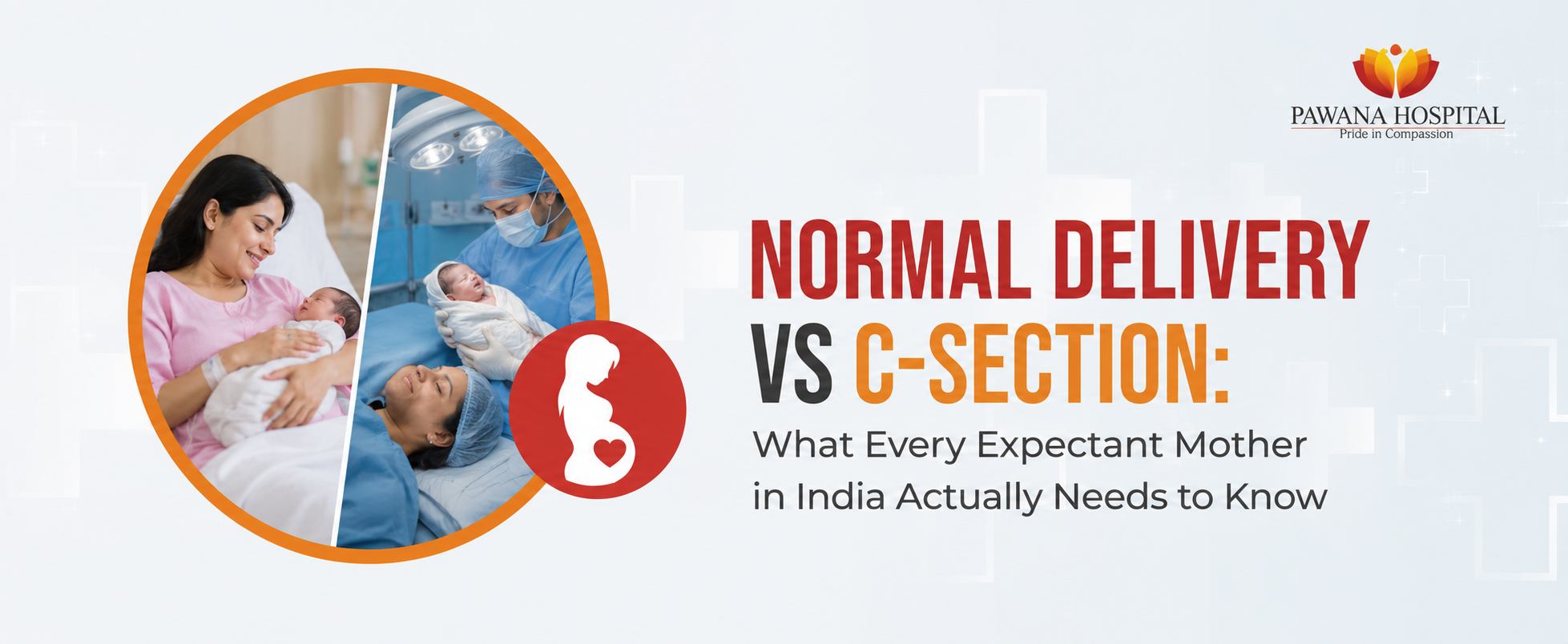
Normal Delivery vs C-Section: What Every Expectant Mother in India Actually Needs to Know
Table of Contents
ToggleBy Pawana Hospital Team | Gynecologist | July 2026 | 10 min read
Nobody tells you how many opinions you’ll get when you’re pregnant.
Your mother-in-law swears by normal delivery. Your colleague had an emergency C-section and says it saved her life. Your neighbour planned a C-section and is embarrassed to admit it. Your doctor has said something about “birth plan” and you’re not entirely sure what yours should be.
By the time most Indian women reach their third trimester, they’ve received so much conflicting advice that the actual medical picture gets buried under fear, guilt, and family pressure — in both directions.
This guide is an attempt to cut through all of that. We’ll look at what normal delivery and C-section actually involve, what the medical reasons are for choosing one over the other, what recovery looks like for both, and — most importantly — why the decision should be made between you and your doctor, not your WhatsApp group.
What Is a Normal (Vaginal) Delivery?
A vaginal delivery — commonly called normal delivery in India — is when the baby is born through the birth canal after the cervix dilates and labour progresses naturally or with medical support (induced labour). It’s how the vast majority of uncomplicated pregnancies were designed to end.
Labour itself unfolds in stages. The first stage involves contractions that gradually open (dilate) the cervix to 10 centimetres — this can take anywhere from a few hours to over 24 hours, especially for first-time mothers. The second stage is active pushing, which typically lasts 30 minutes to 2 hours. The third stage involves delivery of the placenta.
Throughout, a gynaecologist, midwife, or trained nurse monitors the mother’s and baby’s vital signs closely. Pain management options include epidural anaesthesia, which numbs the lower body while keeping the mother conscious, or non-medical techniques like breathing exercises and positioning.
Sometimes an episiotomy — a small incision to widen the vaginal opening — is made to assist delivery or prevent tearing. This is stitched afterward and heals within a few weeks.
Instrumental delivery (using forceps or a vacuum device) may be used if the baby needs help moving through the birth canal in the pushing stage.
What Is a C-Section (Caesarean Delivery)?
A Caesarean section is a surgical delivery — the baby is born through incisions made in the mother’s abdomen and uterus. It’s performed under spinal or epidural anaesthesia (the mother is awake but feels no pain below the waist) or, in emergencies, under general anaesthesia.
The surgery itself takes about 10–15 minutes to deliver the baby, followed by another 30–45 minutes to close the incisions. Recovery in hospital is typically 3–4 days, compared to 1–2 days for a straightforward vaginal delivery.
C-sections can be planned (elective) — scheduled in advance because of a known medical reason — or emergency — performed when complications arise during labour that make continuing vaginal delivery unsafe for the mother or baby.
Normal Delivery vs C-Section: Key Differences at a Glance
Factor | Normal (Vaginal) Delivery | C-Section |
Anaesthesia | Epidural or none | Spinal/epidural (usually) |
Surgery involved | No | Yes |
Average hospital stay | 1–2 days | 3–5 days |
Recovery time | 4–6 weeks | 6–8 weeks (or longer) |
Pain after delivery | Perineal soreness, manageable | Surgical site pain, more significant |
Future pregnancies | No restriction | Higher risk with each repeat C-section |
Breastfeeding start | Usually immediate | Slight delay, but fully possible |
Risk of surgical complications | Lower | Higher (bleeding, infection, adhesions) |
Baby’s breathing | Slightly aided by birth canal passage | Slightly higher risk of transient breathing issues |
This table is a general guide — individual circumstances change everything. A “riskier” option on paper can be the safest choice for a specific patient.
When Is a C-Section Medically Necessary?
C-sections save lives. There are clear, well-established medical situations where they’re the right — and sometimes only — safe option.
Absolute indications (C-section is required):
- Placenta praevia — the placenta is covering the cervix, blocking vaginal delivery
- Placental abruption — the placenta separates from the uterine wall prematurely, causing bleeding
- Umbilical cord prolapse — the cord slips into the birth canal before the baby, cutting off oxygen
- Foetal distress — the baby’s heart rate patterns indicate lack of oxygen during labour
- Obstructed labour — the baby cannot pass through the birth canal despite strong contractions
- Uterine rupture — extremely dangerous, requires immediate surgical delivery
Common relative indications (C-section is often the safer choice):
- Baby in breech position (feet or bottom first) after attempts to turn the baby haven’t worked
- Previous C-section, depending on the type of uterine incision
- Multiple pregnancy (twins or more) with certain positioning
- Very large baby (macrosomia) relative to the mother’s pelvis
- Certain maternal health conditions — severe pre-eclampsia, active genital herpes, some cardiac conditions
- Failed induction — labour was induced but didn’t progress adequately
What C-section is not medically indicated for: maternal preference alone, convenience scheduling, or fear of labour pain in a pregnancy with no complications. These are valid human feelings, but the decision should involve a clear-eyed conversation with your gynaecologist about the actual risks and benefits in your specific case.
Can You Plan a Normal Delivery? What Helps?
You can’t guarantee a normal delivery — labour has its own plans — but several factors genuinely improve the chances of one going smoothly.
During pregnancy:
- Regular antenatal check-ups are non-negotiable. Most complications that necessitate C-sections are identifiable in advance. Consistent monitoring at Pawana Hospital’s Gynaecology & Obstetrics department means your doctor knows your pregnancy thoroughly before labour begins.
- Weight management — healthy weight gain during pregnancy (typically 11–16 kg for normal BMI) reduces complications.
- Staying active — gentle walking, antenatal yoga, and swimming (where appropriate) maintain fitness and can ease labour.
- Birth preparation classes — breathing techniques, understanding the stages of labour, and knowing what to expect genuinely reduce anxiety-driven complications.
- Iron and nutrition — anaemia increases labour risk. Regular haemoglobin checks and adequate iron intake matter.
Position of the baby: Around 36 weeks, your doctor will check whether the baby is head-down (cephalic). If not, certain exercises or manual techniques (external cephalic version) may help. This is worth discussing early.
Your hospital’s approach matters too. Facilities with 24/7 obstetrician availability, neonatal ICU, and emergency OT — like Pawana Hospital — allow labour to progress safely with immediate backup if anything changes. The ability to monitor and respond quickly is what makes the difference between a normal delivery that goes well and an emergency that’s managed too late.
Recovery: What the First Weeks Actually Look Like
Both types of delivery involve real recovery. Neither is the “easy” option.
After a normal delivery:
The first 24–48 hours involve perineal soreness, afterpains (uterine contractions as it returns to size), and exhaustion. If there was an episiotomy or tear, the stitches dissolve on their own within a few weeks.
Most women feel meaningfully better by 2–3 weeks. Full recovery — internally and externally — takes about 6 weeks. Breastfeeding typically begins within the first hour, which aids uterine recovery.
After a C-section:
The surgical site needs more careful management. The first few days are more painful — moving, coughing, and laughing are uncomfortable. You’ll need help getting up. Pain medication is prescribed and should be taken as directed.
Driving is off the table for 4–6 weeks. Lifting anything heavier than your baby is restricted for several weeks. The incision scar fades over 6–12 months.
Full internal healing takes longer than the external scar suggests — the uterine incision needs 6 months to a year to fully heal, which is relevant for the timing of future pregnancies.
Both deliveries: Postpartum emotional changes — baby blues, mood swings, and in some cases postpartum depression — are real and common regardless of delivery type. These are not weakness; they’re hormonal and psychological transitions that deserve attention and support. If you’re feeling persistently low, anxious, or disconnected from your baby after delivery, please tell your doctor.
What About the Baby — Does the Delivery Method Matter? {#delivery-method-and-baby}
For most healthy babies, the delivery method has minimal long-term impact. Both vaginal and C-section births produce healthy children every day.
A few nuances worth knowing:
Babies born vaginally are exposed to the mother’s vaginal microbiome during delivery — research suggests this may have some immune and gut health benefits, though the long-term significance is still being studied and should not be overstated.
Babies born by C-section have a slightly higher rate of transient tachypnoea (temporary fast breathing) because they miss the “squeeze” of the birth canal that clears fluid from the lungs. This usually resolves within hours and rarely requires significant intervention.
For premature babies or those with known health concerns, the delivery method is part of a more complex medical decision involving neonatologists. Pawana Hospital’s NICU and PICU are equipped to care for newborns who need specialised support immediately after birth.
VBAC: Can You Have a Normal Delivery After a Previous C-Section?
VBAC — Vaginal Birth After Caesarean — is possible for many women, and is increasingly supported in modern obstetric practice. It’s not the automatic repeat C-section that it once was.
Whether you’re a good candidate depends on:
- The type of uterine incision from your previous C-section (a low transverse incision — the most common — carries lower risk of uterine rupture during VBAC)
- How many previous C-sections you’ve had
- The reason for the previous C-section (if it was a one-time issue like breech position, VBAC success rates are higher)
- Your current pregnancy — baby size, position, and absence of new complications
- The gap between pregnancies
VBAC requires delivery in a facility with immediate access to emergency C-section capability if needed. If you had a C-section previously and want to explore your options for the next pregnancy, bring it up early — not in the third trimester.
Questions to Ask Your Gynaecologist
Don’t go into your antenatal appointments passively. These questions are worth asking:
- Based on my pregnancy so far, what type of delivery are you expecting?
- What are the specific risk factors in my case that might affect the delivery?
- What are your hospital’s C-section rates, and under what circumstances do you recommend one?
- If I go into labour naturally, at what point would you intervene?
- What pain relief options are available, and what do you recommend for my situation?
- If I’ve had a C-section before, am I a VBAC candidate?
- What should I know about your NICU facilities in case the baby needs support?
A gynaecologist who welcomes these questions — rather than brushing them aside — is one you can trust with one of the most important events of your life.
FAQs
Is a C-section safer than normal delivery? Neither is universally “safer.” Each carries different risks in different situations. For a normal, uncomplicated pregnancy, vaginal delivery carries lower surgical risk. For specific complications, C-section is the safer option. Your doctor evaluates your specific situation.
Does a C-section hurt more than normal delivery? During the procedure, neither should be painful — both use anaesthesia. Post-delivery, C-section recovery tends to be more painful and longer because it’s a surgical wound. Normal delivery has its own discomfort — contractions, possible tearing — but recovery is typically faster.
Will I definitely need a C-section if my baby is large? Not necessarily. A large baby (macrosomia) is one factor — but the mother’s pelvis size, the baby’s position, and how labour progresses all matter. Many large babies are delivered vaginally without complications. Your doctor will assess the full picture.
Can I choose a C-section without a medical reason? In India, maternal request C-sections happen but aren’t routine. Reputable hospitals will want to ensure you understand the risks — surgical complications, longer recovery, impact on future pregnancies — before proceeding without a medical indication.
How soon can I get pregnant after a C-section? Most gynaecologists recommend waiting at least 18–24 months after a C-section before the next pregnancy, to allow the uterine scar to heal adequately. Conceiving too soon increases the risk of uterine rupture in a subsequent pregnancy.
Does the type of delivery affect breastfeeding? Both types of delivery are fully compatible with breastfeeding. C-section mothers may have a slight delay in milk coming in, but with good support and frequent feeding, breastfeeding works well for most.
Conclusion
The normal delivery vs C-section question doesn’t have a single right answer — and anyone who tells you otherwise, whether they’re pro-natural or pro-caesarean, is oversimplifying something genuinely complex.
What matters is this: a healthy mother and a healthy baby. Everything else — the birth story, what method was used, whether there was an epidural — is secondary to that outcome.
What you can do is prepare well. Attend all your antenatal check-ups. Ask questions. Understand your own risk factors. Choose a hospital with the infrastructure to handle both planned and emergency situations. And trust a gynaecologist who takes the time to explain, not one who just tells you what to do.
The Gynaecology & Obstetrics department at Pawana Hospital handles everything from routine antenatal care to high-risk pregnancies, supported by a NICU for newborns who need immediate care. With over 25 years of experience serving families across Maval, Talegaon, and Pune, the team is equipped for both the expected and the unexpected.
To book an antenatal consultation visit the contact page.
You don’t have to figure this out alone. That’s what your doctor is there for.
This Blog is for general informational purposes and does not replace personalised medical advice. Please consult your gynaecologist for guidance specific to your pregnancy.