Slip Disc: Symptoms, Causes, Treatment and When Surgery Is Needed
Table of Contents
TogglePawana Hospital Team
By Pawana Hospital Team | Gynecology & Endocrinology | August 2026 | 9 min read
Back pain and neck pain are extremely common, but when the pain begins travelling into an arm or leg, causes numbness or tingling, or is accompanied by muscle weakness, the problem may involve a spinal disc and nearby nerves.
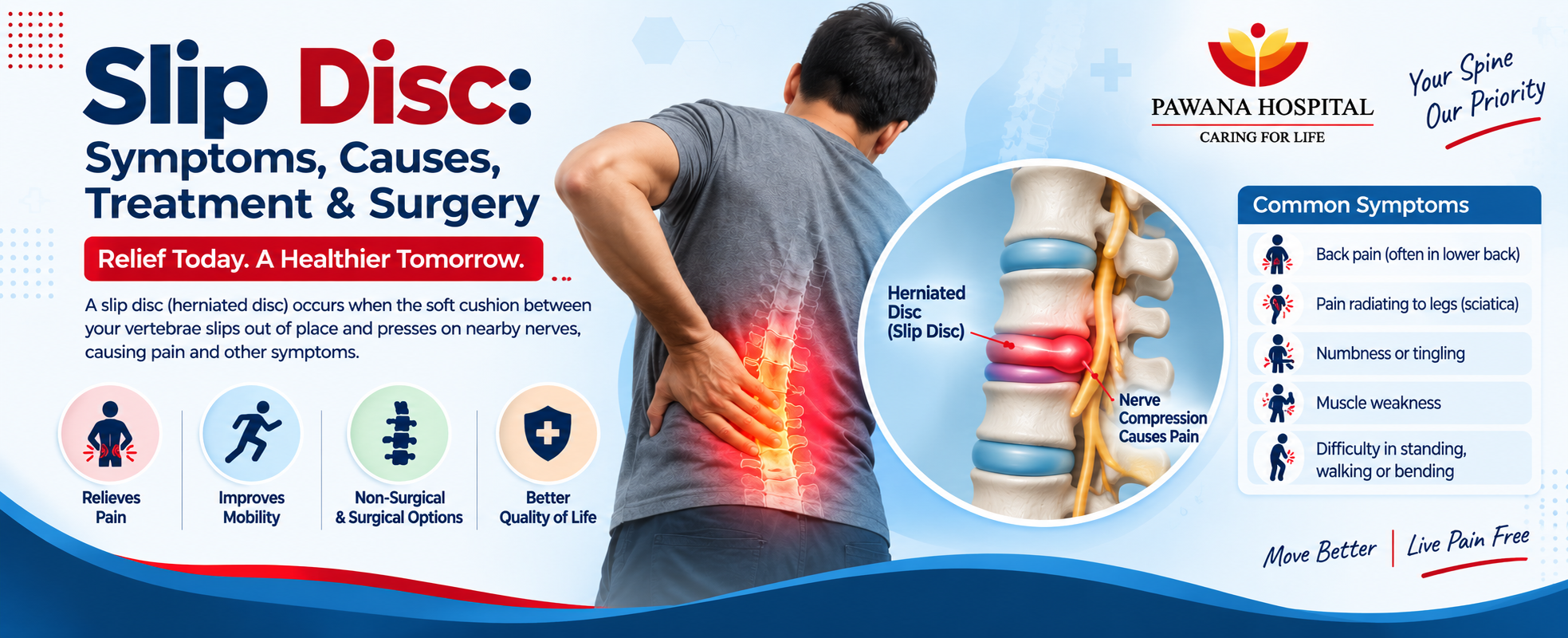
A slip disc, commonly called a herniated or prolapsed disc, can occur when the soft inner portion of a spinal disc pushes through or irritates its outer layer. Depending on its location and severity, the affected disc may put pressure on nearby nerves and cause symptoms extending beyond the back or neck.
The good news is that many people with a slip disc improve with appropriate non-surgical treatment. Surgery is generally considered only in selected situations, particularly when symptoms remain severe despite treatment or significant nerve compression causes neurological problems.
Understanding the symptoms and warning signs can help patients seek appropriate spine care at the right time.
Introduction – Understanding Slip Disc Your spine is made up of a series of bones called vertebrae. Between these bones are spinal discs that act as cushions, absorb shock, and help the spine move smoothly.
Over time, these discs can become less flexible and more vulnerable to injury. Sometimes, part of a disc bulges or herniates and irritates a nearby spinal nerve.
The symptoms can vary significantly. Some people may have a disc problem visible on imaging but experience very little discomfort. Others may develop severe radiating pain, numbness, tingling, or weakness because a nerve is being compressed.
Slip disc most commonly affects the lower back (lumbar spine) or neck (cervical spine).
What Is a Slip Disc?
A spinal disc has a softer, gel-like centre surrounded by a tougher outer layer.
When the outer portion becomes weakened or damaged, the inner disc material may push outward. This is commonly referred to as a herniated disc, prolapsed disc, or slip disc.
The term “slipped disc” can be misleading because the entire disc does not actually slip out of position. Instead, part of the disc bulges or herniates. Problems arise when this change irritates or compresses nearby nerves.
What Causes a Slipped or Herniated Disc?
One of the most common causes is gradual age-related wear and tear of the spinal discs, known as disc degeneration.
As we age, spinal discs may lose some of their water content and flexibility. This can make them less capable of absorbing stress and more susceptible to damage.
Other possible triggers include:
- Lifting a heavy object incorrectly
- Sudden twisting movements
- Repeated bending and lifting
- Excessive strain on the spine
- Falls or injuries Long-term poor posture
- Repetitive physical work
Sometimes a herniated disc develops gradually without a single obvious injury.
Common Risk Factors
Certain factors may increase the likelihood of developing disc-related problems.
Increasing Age:
Spinal discs naturally undergo degenerative changes over time, making disc problems more common with increasing age.
Excess Body Weight:
Additional body weight can increase mechanical stress on the lower spine and may contribute to back problems.
Sedentary Lifestyle:
Long periods of sitting combined with inadequate physical activity can contribute to weak supporting muscles and poor posture.
Repetitive Physical Work:
Jobs involving frequent lifting, bending, pulling, pushing, or twisting can place repeated stress on the spine
Smoking:
Smoking can negatively affect overall spinal and disc health and is associated with degenerative spinal changes.
Cervical vs Lumbar Slip Disc Symptoms
1. Cervical Slip Disc:
A cervical slip disc occurs in the neck.
Symptoms may include:
- Neck pain Pain around the shoulder blade
- Pain travelling into the shoulder or arm
- Tingling or numbness in the arm or hand
- Weakness involving certain arm or hand muscles
- Pain aggravated by particular neck movements
2.Lumbar Slip Disc:
A lumbar slip disc occurs in the lower back and is one of the most common locations for disc herniation.
Symptoms may include:
- Lower-back pain
- Pain travelling through the buttock into the leg
- Numbness or tingling in the leg or foot
- Muscle weakness
- Difficulty walking or standing
- Pain aggravated by certain movements, coughing, or sneezing
Radiating leg pain associated with irritation of the sciatic nerve is commonly referred to as sciatica.
Slip Disc and Sciatica – What Is the Connection?
Sciatica is not itself a type of slip disc.
Instead, sciatica describes symptoms caused by irritation or compression of the sciatic nerve or its contributing nerve roots.
The sciatic nerve extends from the lower back through the buttocks and down the legs. When a disc in the lower spine affects a nerve root contributing to this pathway, patients may experience pain that travels from the lower back or buttock down one leg.
Sciatica may also cause:
- Burning or shooting pain
- Tingling
- Numbness
- Leg or foot weakness
Not every case of sciatica is caused by a herniated disc, which is why proper diagnosis is important before treatment begins.
How Is a Slip Disc Diagnosed?
Diagnosis usually starts with a detailed medical history and physical examination.
The doctor may ask:
• Where the pain started Where the pain travels
• How long symptoms have been present
•Whether numbness or tingling occurs
• Whether muscle weakness has developed
• Which activities make symptoms better or worse
•Whether there has been a recent injury
During the physical examination, the doctor may assess muscle strength, reflexes, sensation, movement, walking ability, and signs of nerve irritation.
MRI Scan
An MRI is commonly used when detailed imaging of spinal discs, nerves, and surrounding soft tissues is required.
It can help identify:
• Location of a herniated disc
•Severity of the disc problem
• Nerve compression
•Other spinal abnormalities
Not every person with back pain requires an immediate MRI. Imaging is usually recommended based on symptoms, clinical findings, duration of the problem, and the presence of warning signs.
Non-Surgical Treatment Options
A diagnosis of slip disc does not automatically mean surgery is required.
Many patients can improve with conservative treatment.
Depending on the severity of symptoms, treatment may include:
Medication
Doctors may prescribe appropriate medicines to reduce pain and inflammation or manage nerve-related pain.
Medication should be taken according to medical advice rather than continued indefinitely without evaluation.
Activity Modification
Short-term modification of activities that aggravate symptoms may allow inflammation and nerve irritation to settle.
However, prolonged complete bed rest is generally not the goal. Appropriate movement and gradual return to normal activities may form part of recovery.
Physiotherapy
Physiotherapy can play an important role in recovery by helping restore movement, strengthen supporting muscles, and improve posture.
Other Non-Surgical Interventions
In selected cases where symptoms remain significant, specialists may consider additional painmanagement or spinal interventions depending on the underlying problem.
Treatment should be individualised according to symptoms and examination and imaging findings.
Physiotherapy & Lifestyle Changes
Physiotherapy is an important component of conservative treatment for many patients with disc-related back or neck pain.
A physiotherapy programme may focus on:
• Improving flexibility Strengthening core muscles
• Improving spinal stability
• Correcting posture Improving movement patterns
• Gradually returning to normal activities
• Learning safer lifting techniques
Patients may benefit from maintaining a healthy body weight, exercising regularly, avoiding prolonged sitting, improving workstation ergonomics, and taking regular movement breaks during desk work.
Exercises should ideally be selected according to the individual’s condition. An exercise that helps one type of back problem may not necessarily be suitable for another.
When Is Slip Disc Surgery Needed?
Surgery may be considered when appropriate non-surgical treatment does not provide sufficient improvement or when significant nerve compression creates a risk of neurological problems.
Possible reasons a spine specialist may consider surgery include:
• Persistent severe radiating pain despite adequate conservative treatment
•Progressive muscle weakness
• Significant nerve compression on imaging that corresponds with symptoms
• Increasing neurological problems
•Symptoms severely affecting walking or daily activities
•Certain emergency neurological complications
The decision is not based on an MRI report alone.
A spine surgeon considers the patient’s symptoms, physical examination, neurological findings, imaging results, overall health, and response to previous treatment before recommending an operation
Warning Signs That Need Immediate Medical Attention
Most back pain is not an emergency, but certain symptoms require urgent medical evaluation.
Seek immediate medical attention if back pain or suspected slip disc is accompanied by:
• New loss of bladder control
• New loss of bowel control
•Numbness around the groin, inner thighs, or saddle area
• Rapidly worsening leg weakness Severe weakness affecting walking
•Significant symptoms following major trauma
These symptoms may indicate serious compression of the nerves in the lower spine, including a condition known as cauda equina syndrome, which requires urgent assessment.
Severe back pain accompanied by fever, unexplained weight loss, or a history of serious underlying disease also warrants prompt medical evaluation.
Recovery and Prevention Tips
Recovery time varies depending on the severity of the disc problem, nerve involvement, overall health, occupation, and treatment required.
To support recovery and reduce the risk of recurring back problems:
Maintain good posture:
Keep the spine supported when sitting and avoid remaining in one position for extended periods.
Lift correctly:
Bend at the knees, keep the object close to the body, and avoid twisting while carrying heavy loads.
Strengthen supporting muscles:
Appropriate core and back-strengthening exercises can improve spinal support.
Stay physically active:
Regular activity helps maintain flexibility, strength, and general musculoskeletal health.
Maintain a healthy weight:
Reducing unnecessary load on the spine may help decrease mechanical stress.
Improve workplace ergonomics:
Adjust your chair, monitor, desk, and working position if you spend long hours sitting.
Follow your rehabilitation plan:
Returning to heavy physical activity too quickly may aggravate symptoms.
Role of Physiotherapy in Slip Disc Recovery
Pain Management: Physiotherapy can help reduce pain and discomfort associated with a slip disc.
Improve Mobility: Gentle exercises and stretching can help improve flexibility and restore normal movement.
Muscle Strengthening: Strengthening exercises help support the spine and improve overall stability.
Posture Correction: Physiotherapists can guide patients on maintaining proper posture to reduce strain on the spine.
Mobility Exercises: Specific exercises may help improve movement and reduce stiffness.
Ergonomic Guidance: Advice on sitting, standing, lifting, and workplace posture can help prevent further strain.
Long-Term Spine Health: A structured physiotherapy program can support recovery and help maintain spine health.
Professional Guidance: Physiotherapy should be performed under the supervision of a qualified physiotherapist, particularly when symptoms are severe or persistent.
Spine Care at Pawana Hospital
Persistent back pain, radiating leg or arm pain, numbness, tingling, or muscle weakness deserves proper medical evaluation, particularly when symptoms interfere with everyday activities.
At Pawana Hospital, patients with spine-related conditions can receive evaluation and treatment based on their symptoms and clinical findings.
Assessment may involve physical and neurological examination and appropriate imaging investigations when required. Treatment can range from medication, activity modification and physiotherapy to specialist evaluation for patients who may require surgical management.
The objective of spine treatment is not simply to treat an MRI finding. It is to identify the actual cause of the patient’s symptoms, relieve nerve compression when necessary, restore function, and help the patient return safely to normal activities.
If back or neck pain continues despite rest and appropriate initial treatment — particularly when it is accompanied by radiating pain, numbness, tingling, or weakness — a spine specialist evaluation can help determine the next appropriate step.
FAQs
Q: Is a slip disc the same as a herniated disc?
“Slip disc” is a commonly used term for a herniated or prolapsed disc. The disc itself does not usually slip completely out of position. Instead, part of the inner disc material pushes through or affects the outer portion of the disc.
Q: Can a slip disc heal without surgery?
Many patients improve with non-surgical treatment such as appropriate medication, activity modification, physiotherapy, and gradual rehabilitation. Surgery is generally reserved for selected cases.
Q:How do I know if my back pain is caused by a slip disc?
Back pain alone cannot confirm a slip disc. Radiating pain, numbness, tingling, or weakness may suggest nerve involvement, but proper clinical examination is necessary to determine the cause.
Q: Does every slip disc require an MRI?
No. Doctors usually decide whether imaging is necessary based on symptoms, examination findings, duration of pain, neurological symptoms, and warning signs.
Q: When is surgery recommended for a slip disc?
Surgery may be considered when severe symptoms persist despite appropriate conservative treatment, significant nerve compression causes progressive neurological problems, or emergency nerve-compression symptoms develop.
Conclusion
A slip disc can cause much more than ordinary back or neck pain. When a herniated disc irritates or compresses a spinal nerve, symptoms may travel into the arms or legs and cause numbness, tingling, weakness, or difficulty performing everyday activities.
However, having a slip disc does not automatically mean you need spine surgery.
Many patients can improve with appropriate medication, physiotherapy, activity modification, lifestyle changes, and structured rehabilitation. Surgery is generally considered when conservative treatment does not provide adequate relief or when significant nerve compression causes progressive neurological symptoms.
The most important step is getting the condition correctly evaluated rather than relying only on pain symptoms or an imaging report.
If back or neck pain is persistent, radiates into an arm or leg, or is accompanied by numbness or weakness, consult a spine specialist for appropriate evaluation.
If bladder or bowel control changes, saddle-area numbness, or rapidly worsening weakness develops, seek emergency medical care immediately.